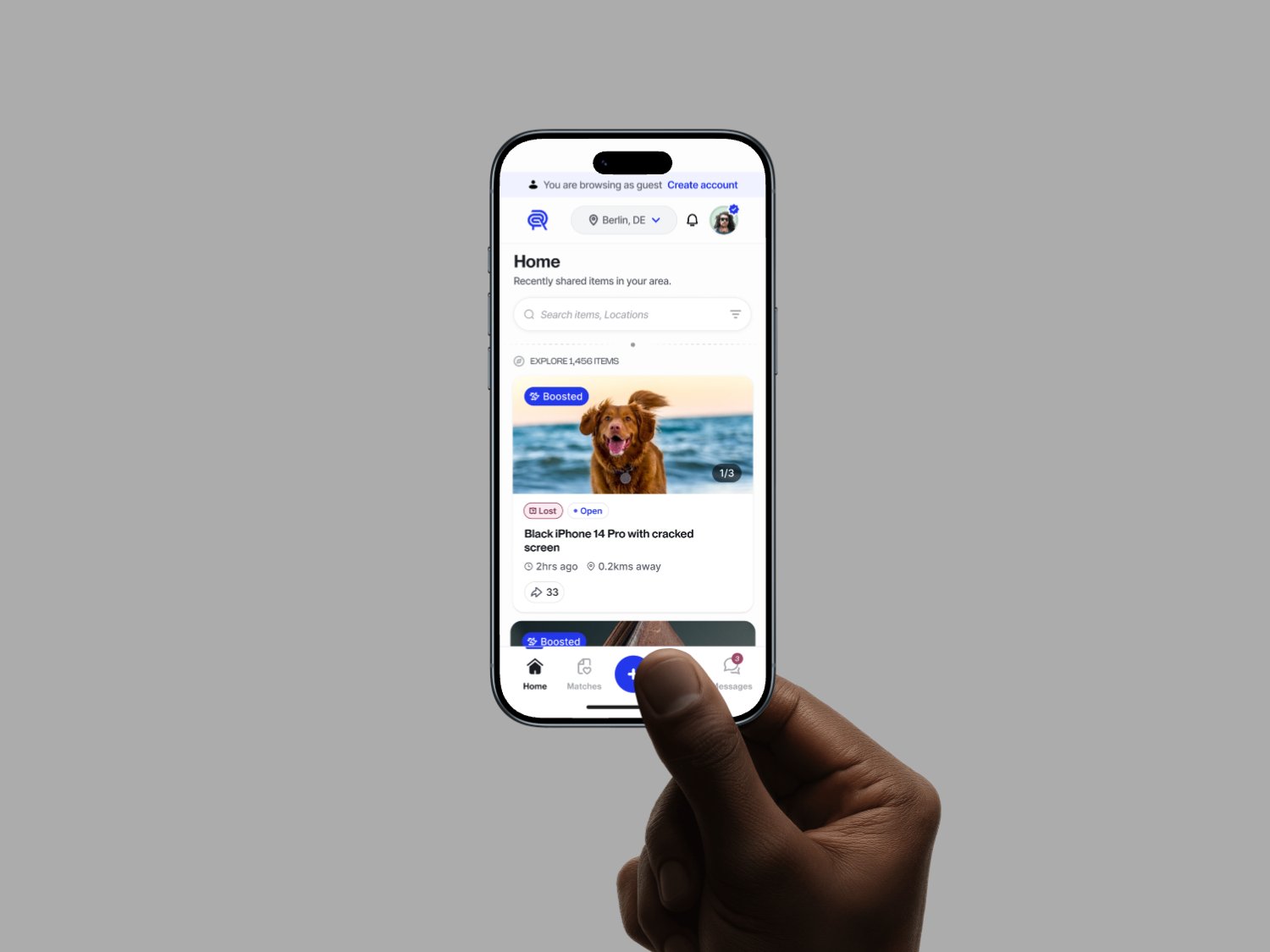
I led product design for Renuir, a complete mobile platform for Europe's lost-and-found ecosystem: onboarding, item reporting, AI-powered matching, ownership verification, secure delivery coordination, and trust-building features. 47 screens, end to end, across B2C and B2B. It is currently in TestFlight and goes live in July 2026.
People who lose personal belongings in public spaces, transit, and events, plus finders who want to return items without hassle
A mobile platform that connects lost items with their owners through AI matching, ownership verification, and coordinated return
Immediately after losing or finding an item, when urgency is highest and existing systems fail to provide any clear next step
Public transit, airports, events, cafes, and shared spaces across European cities, starting with Berlin
Most lost items are never returned. Lost-and-found offices operate in silos, finders have no clear way to return items, and no cross-organization protocol exists
Camera-first item reporting, AI photo matching, multi-step ownership verification, safe meetup coordination, and shipping integration
From our interviews and operator conversations: most lost items in European transit systems are never reunited with their owners, because the process is fragmented.
Interviewees described stopping the active search within the first day, worn down by friction in reporting and searching.
Our competitive scan found no protocol-layer solution that standardizes lost-and-found across organizations and countries.
Our service blueprint surfaced the moments where items get permanently lost in the current system.
I spent 6 weeks in discovery before designing a single screen. I interviewed people who lost items, people who found items, and lost-and-found office operators. I mapped the regulatory landscape across Germany and the EU to understand legal requirements around found property.
Spoke with 8 "losers" (people who lost items), 4 "finders," and 4 lost-and-found operators across Berlin, Munich, and Amsterdam. Key finding: the emotional distress of losing items is severely underestimated. It is not just about the object's monetary value.
Analyzed 8 solutions (iLost, Tile, Foundit, BVG Fundburo). Most were device-only (Tile) or single-organization (iLost). None offered a true cross-organization protocol. This validated our infrastructure-first approach.
German law (BGB sections 965-984) defines legal obligations for finders. EU GDPR adds complexity around sharing personal data between parties. These constraints directly shaped the ownership verification and data-handling flows.
Created an end-to-end blueprint mapping frontstage interactions, backstage processes, and support systems. This revealed the 7 critical handoff points where items typically get lost in the current system.
"I left my wallet on the S-Bahn. By the time I realized, I had no idea where to start looking."
"I found someone's bag at a cafe. I wanted to return it but had no idea how without it being awkward."
"Our lost-and-found office is drowning in unclaimed items. We need a system that works with our existing processes."
The critical design challenge was creating a flow that is fast (users want immediate resolution) while remaining secure (ownership must be verified to prevent fraud). Every step had to build trust incrementally.
The onboarding communicates three value props through illustrated screens: report, match, return. Sign-up uses email plus OTP for simplicity, with Google SSO as an alternative. Item reporting is camera-first: photograph the item, add details, pin the location, and post.
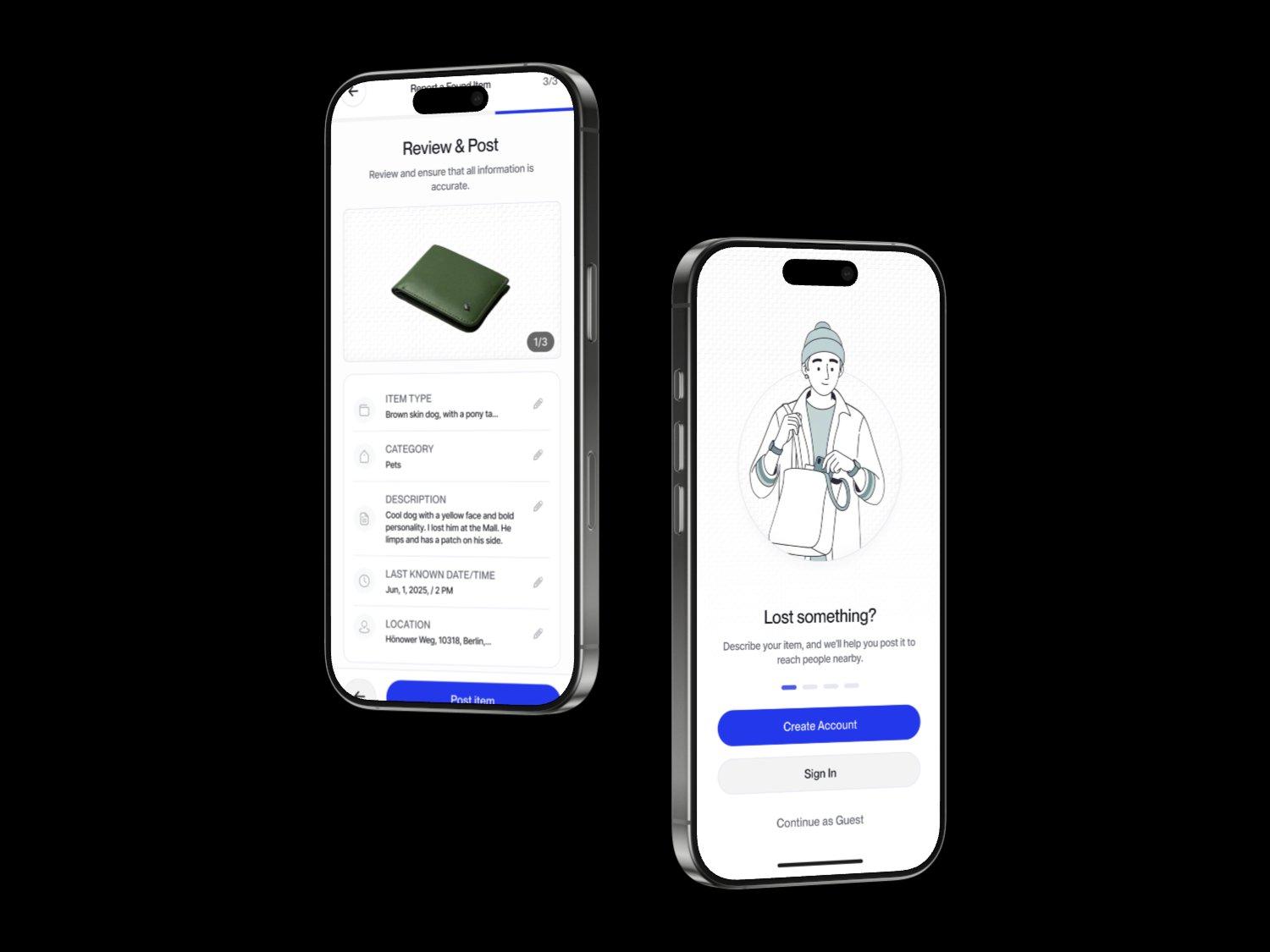
Onboarding, then a camera-first flow to report an item.
When the AI finds a potential match, both parties see a match confidence score (e.g., 98%). The finder reviews ownership proof (serial numbers, photos, purchase receipts) before approving. In-app messaging coordinates the return without sharing personal contact details.
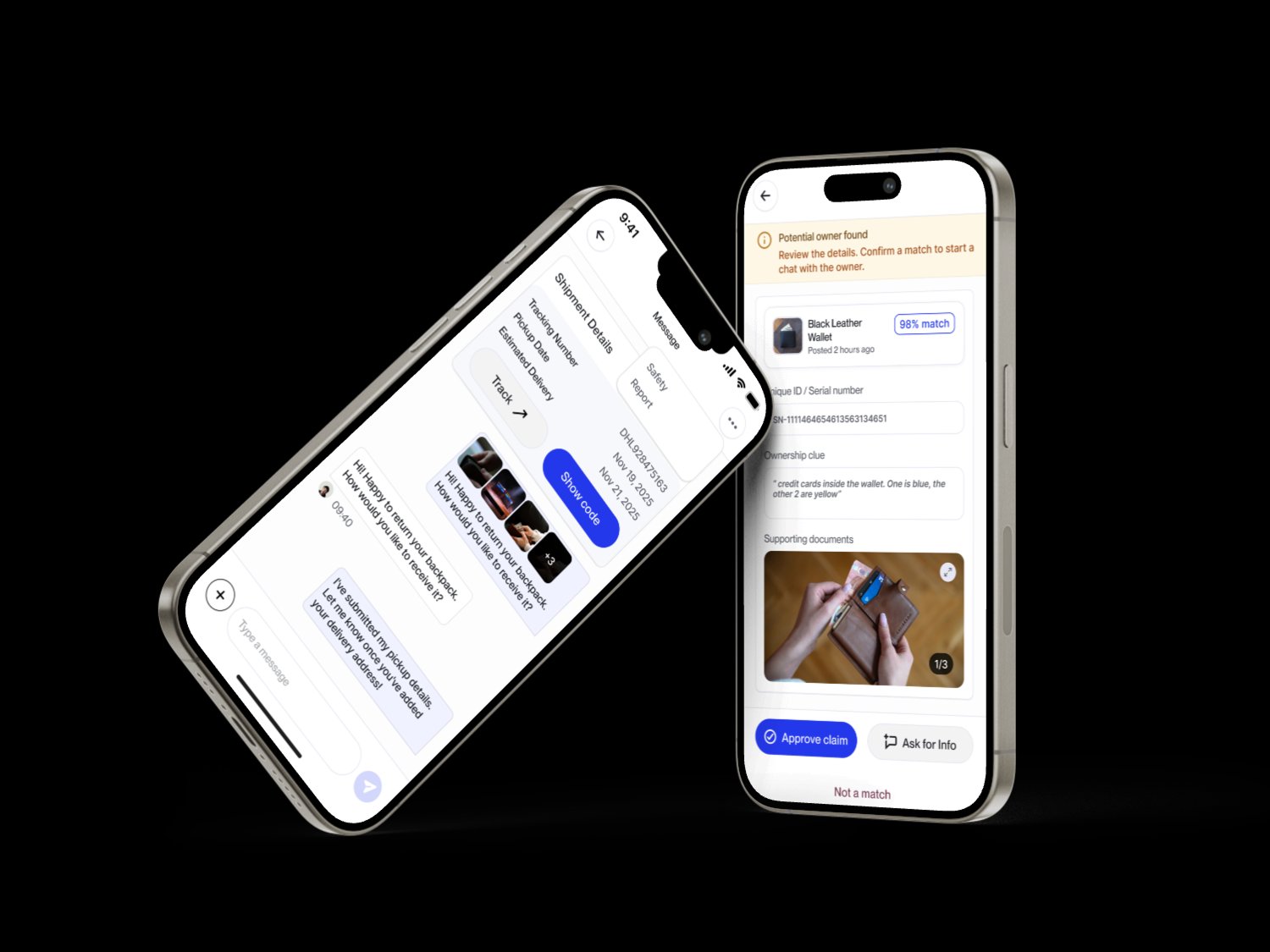
Match confidence, then a private chat to coordinate the return.
Owners prove the item is theirs with serial numbers, receipts, photos, or warranty documents. The return then happens the way that suits them: an in-person handover at a suggested safe public place, confirmed with a 4-digit code, or shipping through an integrated delivery partner with live tracking. When the evidence does not add up, the finder can decline a claim, and the claimant is told respectfully.
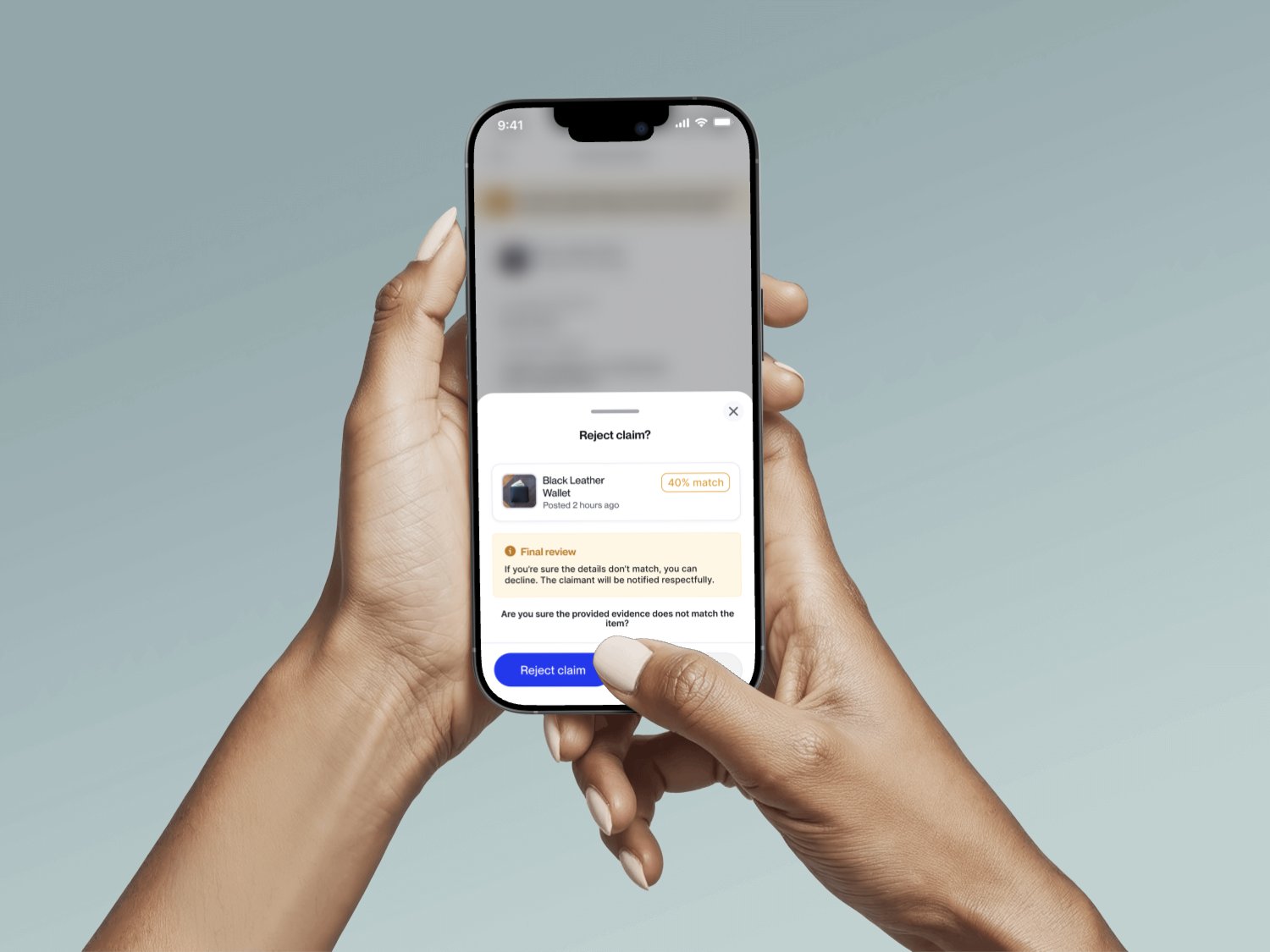
Resolution is built to protect both sides, including a respectful decline.
Tested with people who had recently lost items, frequent public transit users, and hostel travelers. Used both moderated sessions for qualitative depth and Maze for quantitative validation.
21% struggled with document upload. The multi-select interface confused users. Simplified to progressive disclosure: one proof type at a time with clear examples.
Users loved safe meeting spots but wanted to know why they were "safe." Added rationale labels: "Police station: public, CCTV, staff present."
5 of the 6 moderated testers said the "98% match" indicator gave them confidence the system was working. Without it, users questioned whether the match was real.
Wrong code error was unclear. Added: "Code does not match. Ask the other person to show their code screen" with retry.
In a platform where strangers exchange personal belongings, every interaction must build trust. Trust is not a feature. It emerges from dozens of small decisions: clear language, verification steps, safety features, and transparent processes.
With limited resources, I developed the framework "What is the minimum viable trust?" The smallest set of features that makes someone comfortable handing belongings to a stranger through the platform.
The component library I built supports the mobile app, a B2B admin dashboard, and API documentation from the same token set. New flows can be assembled in hours, not weeks.
German found-property law and GDPR initially felt like obstacles. They turned out to be forcing functions that made the verification flow more trustworthy. Legal requirements and good UX aligned perfectly.